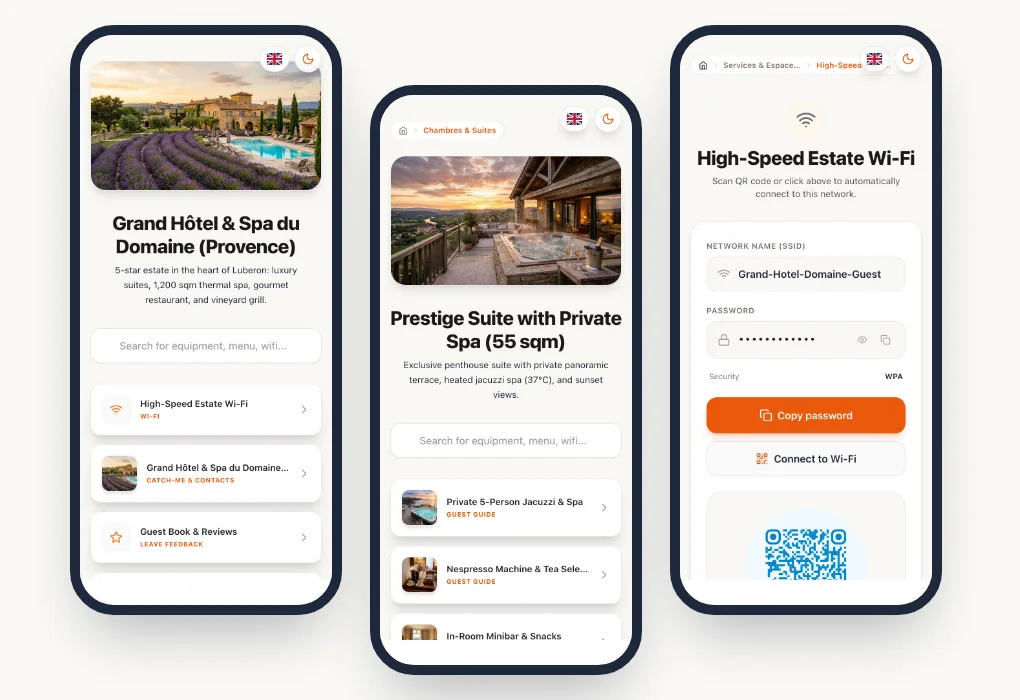
The welcome is a big part of the experience of a short-term rental stay. Guests who find the property easily, get in without trouble and immediately understand how the equipment works start their stay relaxed. A complicated arrival, on the other hand, leaves an impression that often shows up in the final review.
Here are the practical levers to improve your guests' welcome while reducing the time you spend on it.
In short
Prepare the arrival before the stay, make self check-in simple and illustrated, answer recurring questions in a digital welcome guide, put QR codes on equipment, translate instructions, and invite every guest to share their feedback.
1. Prepare the arrival before the stay
The welcome starts before guests put down their suitcase. A few days before arrival, a clear message avoids most last-minute questions:
- the exact address and directions;
- possible arrival times;
- how to access the property;
- the link to your digital welcome guide.
Sending the guide in advance lets guests read it calmly, rather than discovering it at 11 pm in front of the door.
2. Simplify self check-in
Guests and hosts both appreciate self check-in, as long as there is no ambiguity:
- photos of the building, the door and the key box;
- numbered steps: door code, floor, door, key box;
- a plan B: the number to call if the code doesn't work.
A short video of the route from the street to the door is often clearer than any text.
3. A digital welcome guide that is always up to date
Paper binders get damaged and quickly go out of date: new Wi-Fi password, new waste sorting rules, a closed shop. A welcome guide opened by QR code solves this: you edit online, and guests always see the right version.
Gather the questions that come back at every stay: Wi-Fi, heating or air conditioning, appliances, waste sorting and check-out. Our article on creating a personalised Airbnb welcome guide details the content to include.
4. Put QR codes on equipment
To avoid evening messages asking how to start the oven or adjust the air conditioning, stick a QR code directly on the trickiest appliances. Scanning it opens the guide for that specific piece of equipment.
Enrich each guide with a photo or a short video tutorial: opening the roller shutters, starting the pool, accessing the garage. A 20-second video is often better than a long paragraph.
5. Make Wi-Fi instant
The Wi-Fi password is almost every guest's first question. A Wi-Fi QR code lets them connect in one scan, and a Wi-Fi page with a "copy password" button handles phones that don't support automatic connection.
With a dynamic Wi-Fi QR code, you can change the password in your dashboard without reprinting the QR code.
6. Translate instructions for international guests
The language barrier is a common cause of equipment misuse and misunderstandings about house rules. A translated digital guide lets every guest read the instructions in their own language.
At Pliyos, the Airbnb Solo plan includes your original language plus 4 translation languages, chosen from more than 100. Equipment guides are translated along with the welcome guide.
7. Share your favourite places
Your recommendations make the difference between a place to sleep and a great stay: bakery, restaurants, market, activities, beaches. Put them in the guide with a personal note, rather than an impersonal list.
8. Invite guests to leave feedback
Before check-out, simply invite every guest to leave a review on the booking platform. You can also offer them a way to tell you directly about a problem or a suggestion: it's a chance to fix an issue for future stays.
Where to start?
Start by noting the questions guests ask you most often: they are the first sections of your guide. Then add your equipment guides and recommendations, and print your QR codes.
With the Pliyos welcome guide for Airbnb, you can start from your existing guide in PDF or Word format. For every step in detail, read our complete guide to digital Airbnb welcome books.