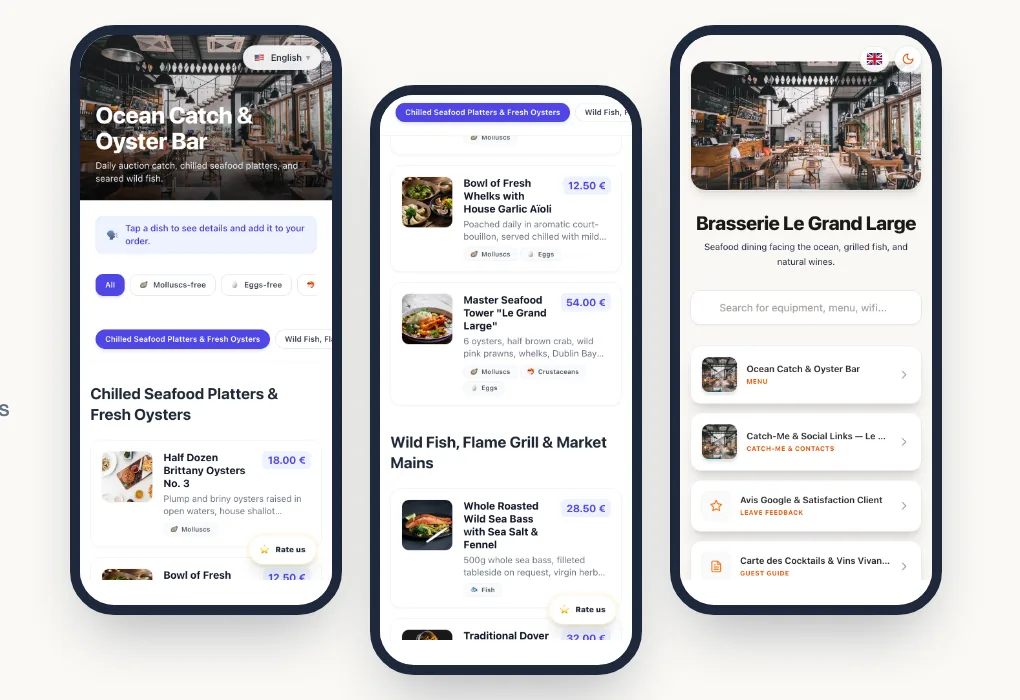
Since the European INCO Regulation came into force, restaurants must tell their guests about the major allergens present in the dishes they serve. The obligation applies to every food business, from food trucks to brasseries, and covers the menu as well as the specials of the day.
This article explains what the rules say, the 14 allergens concerned, and the simplest way to stay compliant without spending hours on it.
In short
The INCO Regulation (EU No 1169/2011) requires restaurants to inform guests of the 14 major allergens present in each dish. Each country sets the practical rules: in France the information must be in writing, while other countries accept oral information backed by written documentation. In every case it must be accurate and accessible before ordering.
What does the INCO Regulation say?
Regulation (EU) No 1169/2011, known as "INCO" (food information to consumers) or "FIC", harmonises food information across the European Union. It distinguishes two situations:
- Prepacked foods, sold in shops, for which allergens must be emphasised in the list of ingredients.
- Non-prepacked foods, which include dishes served in restaurants, as takeaway or for delivery. For these, allergen information is also mandatory, and each member state defines how it must be provided.
National rules differ on the format:
- France requires the information to be given in writing, legibly, and easy for the guest to consult before ordering.
- Germany (LMIDV) and Spain (Royal Decree 126/2015) accept oral information, provided written documentation is available and guests are told where to find it.
- The United Kingdom applies the same 14 allergens. Information can be given orally, but guests must be clearly told how to obtain it.
Whatever the country, "ask the staff" with nothing behind it is a risk: the staff member on duty may not know, and food inspectors expect verifiable information.
The 14 allergens to declare
Allergens often hide in base preparations: a stock, a mustard vinaigrette, breadcrumbs, a compound butter. That is where most omissions happen.
Situations that cause problems
Specials and dishes of the day. They change often and are rarely added to the allergen table, yet the obligation is the same as for the menu.
Supplier changes. Bread, a sauce or a dessert bought from a new supplier may contain an allergen the previous one didn't. Reread the product specifications at every change.
Traces and cross-contamination. Statements such as "may contain traces of" are not governed by the INCO Regulation; they are voluntary. If you use them, be precise and honest rather than adding them everywhere as a precaution.
Paper menus that are never updated. An allergen table printed six months ago no longer reflects the current menu. It is the most common situation found during inspections.
How to display allergens in practice
Restaurants use three main approaches:
- A summary table at the end of the menu or at the counter: simple, but hard to read and to keep up to date.
- Icons on the paper menu: more readable, but every change means a reprint.
- A digital menu: allergens are attached to each dish and update together with the menu. Guests can filter dishes by what they cannot eat.
A digital menu opened by QR code works well, as long as it is easy to access, readable, and you keep an alternative for guests without a phone, such as a folder or paper menu with the same information.
What Pliyos does for allergens
With the Pliyos digital menu, each dish carries its allergens, shown as icons and filters. Guests can exclude in one tap every dish containing, for example, tree nuts or gluten.
When you import your menu, AI analyses descriptions and ingredients to suggest the allergens of each dish.
AI suggestions are an aid, not a guarantee. Always check and approve allergens before publishing: only you know your recipes, base preparations and suppliers. Responsibility for the information remains with the food business.
When a recipe changes, you edit the dish once: the menu, the filters and every enabled language update at the same time.
Good practice to stay compliant
- Work from recipe and supplier specifications, not from memory.
- Appoint someone responsible for updating allergens, in the kitchen and front of house.
- Update on the same day when a recipe or supplier changes.
- Train front-of-house staff to point guests to the written information and to alert the kitchen when an allergy is declared.
- Keep a paper version for guests who don't want to use their phone.
For an overview of switching to a digital menu, read our complete guide to QR code menus.
Frequently asked questions
Is a QR code menu enough to be compliant?
It can be, if it clearly shows the allergens of each dish, is accessible before ordering, and you offer an alternative for guests without a phone. Check the specific rules of your country.
Do I need to declare allergens in drinks?
Yes, the obligation covers all food and drink served. Sulphites in wine and milk in some cocktails are the most common cases.
Who checks allergen information?
Local food safety authorities: for example the DGCCRF and DDPP in France, food control authorities in Germany, or local authority environmental health officers in the United Kingdom.