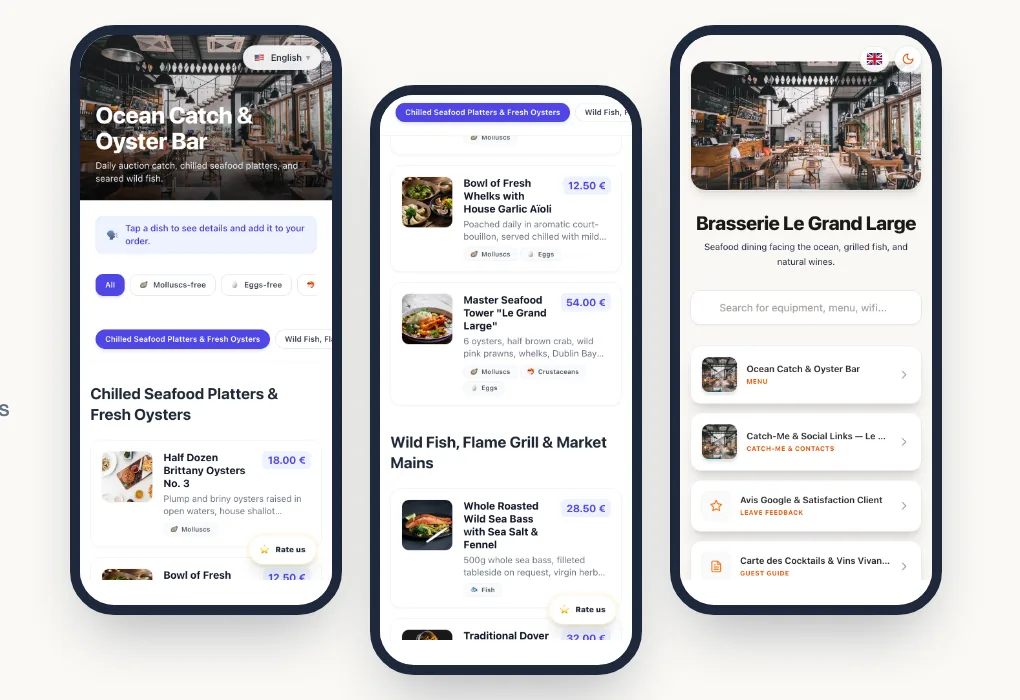
A tourist who can't understand the menu hesitates to come in, orders the one dish they already know, or walks on. In tourist districts, holiday areas and around stations and hotels, menu translation is often what makes the difference between an empty table and a full one.
Here is how to choose your languages, translate your dishes properly and offer a multilingual menu that stays up to date.
In short
Translate into the languages of your real guests, keep the names of specialities with a translated description, translate allergens too, and proofread your signature dishes. A multilingual digital menu saves you from managing several paper menus.
Why translate your menu?
- Guests understand what they order. They dare to step outside their habits and try your specialities.
- Fewer ordering mistakes. Less back-and-forth to explain a dish, fewer dishes sent back.
- A more thoughtful welcome. Reading the menu in their own language is a sign of care that travellers notice and mention in their reviews.
- Food safety. A guest with an allergy must be able to understand allergens, whatever their language.
Which languages should you choose?
It's tempting to translate everything, but a menu in fifteen languages is rarely useful. Start from your actual guests:
- English is almost always essential: it is the common language of most travellers.
- Your neighbours' languages: Spanish, German, Italian or Dutch depending on your region.
- Languages of long-haul visitors: Chinese, Japanese or Korean if you welcome groups or are close to major sights.
Ask your front-of-house team, look at where your online reviews come from and, with a digital menu, at scans by country. These figures quickly show which languages are actually used.
Translating dishes without distorting them
Keep the names of specialities. "Bœuf bourguignon", "blanquette de veau" or "tarte Tatin" don't translate: the name is part of the experience. Add a short description in the guest's language explaining what the dish contains.
Explain technical terms. "Confit", "en croûte", "à la plancha" or "tartare" deserve a few words of explanation. A tourist who discovers that tartare is raw only when it arrives is rarely delighted.
Translate allergens. This is the most important part for safety. A guest allergic to tree nuts must spot it immediately, in their own language.
Avoid word-for-word translation. General-purpose translation tools sometimes produce absurd results on dish names. Culinary context matters.
The most common mistakes
- Translating once and never touching it again. The menu changes, the translation doesn't, and the international guest reads a menu that no longer exists.
- Showing different prices in the original and translated versions, because two documents are managed separately.
- Printing one menu per language. Printing costs multiply, and menus get damaged or lost.
- Forgetting the specials. They often stay in the local language only, on the chalkboard.
- Never proofreading. A mistake on a signature dish gets noticed, and sometimes ends up in a review.
The multilingual digital menu
With a digital menu, you manage a single menu. Guests choose their language on their phone, and every version updates at the same time when you change a price or a dish.
On the Pliyos digital menu, translation is done by AI that takes culinary context into account, and you can then review and adjust each dish. Allergens are translated along with the menu.
The Resto plan includes your original language plus 3 translation languages, chosen from more than 100. Each additional language costs €1 per month. Start with your main languages, and add more if your statistics show demand.
The QR code is the same for every guest: the menu adapts. So you only need one printed QR code per table.
Tips for a successful multilingual menu
- Have your signature dishes proofread by a native speaker at least once.
- Make the language selector obvious, with a short line next to the QR code: "Menu in English, Español, Deutsch…".
- Train your team to point guests to the QR code as soon as they sit down.
- Check which languages are really used, and adjust each season.
To go further on creating the menu, printing QR codes and allergens, read our complete guide to QR code menus.
Frequently asked questions
Is automatic translation reliable for a menu?
It does most of the work, and AI that understands culinary context avoids most mistakes. Proofreading your key dishes is still recommended.
Are prices and allergens translated too?
Prices are identical in every language, since it is the same menu. Allergen names are translated into the language chosen by the guest.
Do I need one QR code per language?
No. One QR code is enough: guests choose their language when they open the menu.