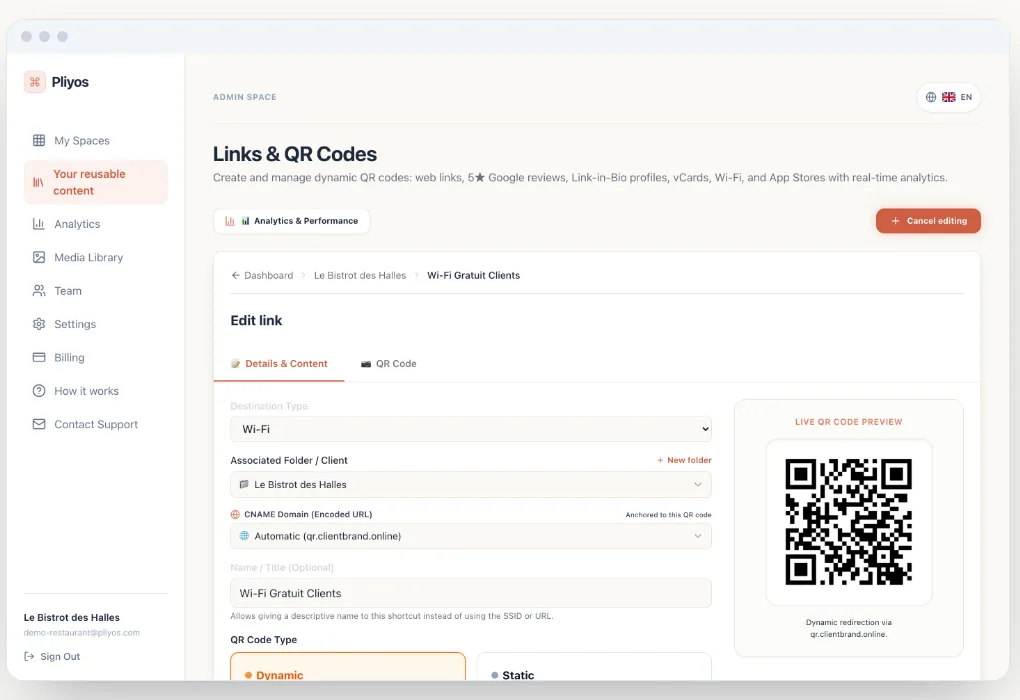
All QR codes look alike once printed, but they don't all work the same way. A static QR code holds the information itself. A dynamic QR code holds a short link that redirects to the information, and that link can be changed at any time.
The choice has practical consequences: being able to fix a mistake after printing, measuring scans, or depending on an online service. Here is how to decide based on your use.
In short
Choose a static QR code for information that will never change (a stable Wi-Fi network, a permanent website address): it is free and works without any third-party service. Choose a dynamic QR code as soon as the destination may change or you want to count scans: you can edit it without reprinting.
How does a static QR code work?
A static QR code encodes the information itself in its black and white squares: a web address, Wi-Fi credentials, a contact card (vCard), a phone number or a pre-written text message. The phone that scans it reads this content directly, without going through any server.
What this means:
- It cannot be edited. If the address changes or contains a typo, you have to generate a new QR code and reprint everything.
- It does not depend on any service. It keeps working as long as the destination exists, even if the tool that created it disappears.
- It gives no statistics. Nobody knows how many times it was scanned.
- The longer the content, the denser the code. A long web address produces a busy QR code that is harder to read when printed small or from a distance.
How does a dynamic QR code work?
A dynamic QR code encodes a short link (for example pliyos.com/7KX4M). When someone scans it, the service redirects to the destination you chose in your dashboard. You can change that destination whenever you want: the printed QR code itself never changes.
What this means:
- It can be edited after printing. New promotion, new menu, moved page: you update the destination in one click.
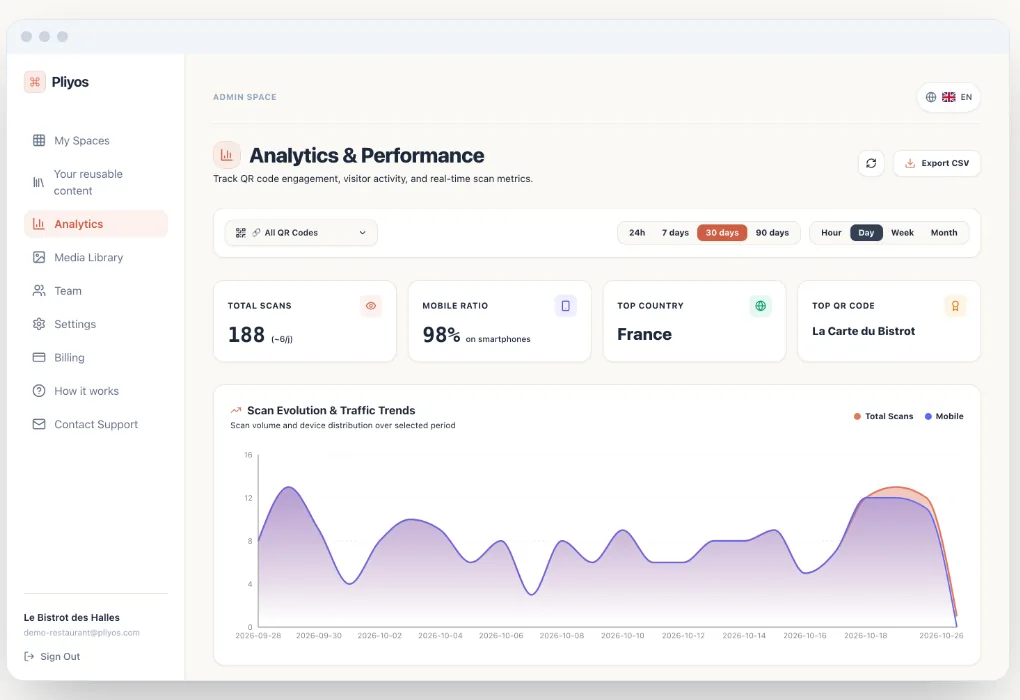
- It measures scans. Number of scans, trend over time and, depending on the plan, countries and device types.
- It stays light. The short link produces a low-density code that scans easily even when printed small.
- It depends on the service. The redirect goes through the provider: if the subscription stops, the QR code no longer leads to your content.
The differences at a glance
When should you choose a static QR code?
Static is the right choice when the information is stable and you don't need to measure anything:
- Wi-Fi at home or in a small venue, if the password doesn't change. The phone joins the network directly after scanning.
- Your business card, if your details are long-lasting.
- A link to your website's home page, whose address won't move.
- One-off use: an invitation, an internal document, a test.
The Pliyos free QR code generator creates static QR codes (URL, Wi-Fi, vCard, SMS, call) that you can download in high resolution, with no sign-up, in your colours and with your logo.
When should you choose a dynamic QR code?
Dynamic is the way to go as soon as the QR code is printed in large numbers or for a long time:
- Restaurant menus, guest directories, window posters: the content changes, the display stays.
- Marketing campaigns: flyers, packaging, trade shows. You redirect to a new offer after the event and compare displays with the statistics. For agencies and brands, our guide to white-label QR codes explains how to deploy them under your own domain name.
- Venue Wi-Fi with a password that changes regularly: the QR code opens a Wi-Fi page you keep up to date, instead of reprinting.
- Customer reviews: the same QR code can point to Google today and to another platform tomorrow.
With Pliyos dynamic QR codes, the QR Starter plan (€5 per month) includes 5 dynamic QR codes with basic statistics, and the QR Pro plan (€15 per month) 30 QR codes with custom design and detailed statistics.
Mistakes to avoid
Never point a static QR code to a temporarily hosted PDF or to a page that may be renamed. The day the link breaks, all your printed materials become useless.
Picking a dynamic QR provider without checking what happens when the subscription ends. Some free services add ads or deactivate codes after a trial period. Read the terms before printing thousands of flyers.
Testing only on your own phone. Scan the printed QR code with several devices, at the real distance of use and under the venue's lighting.
Forgetting the quiet zone. Leave a white margin around the QR code: without it, some phones cannot read it.
Shrinking the QR code too much. For tables or flyers, aim for at least 2 to 3 cm (about 1 inch) per side. For a poster read from afar, scale it up with the distance.
Can you turn a static QR code into a dynamic one?
No: the content of a static QR code is fixed in its pattern. However, if your static QR code points to an address on your own website, you can redirect that address on the server side. It's a workaround, with no statistics and no simple interface. For your next materials, go straight for a dynamic QR code.
Frequently asked questions
Does a static QR code expire?
No. A static QR code has no expiry date: it works as long as its destination exists. What can expire is the page or file it points to.
Is a dynamic QR code less secure?
Not in itself. The redirect goes through the provider's server: choose a reliable service, hosted in Europe if you are subject to GDPR, that does not resell scan data.
Do dynamic QR code statistics collect personal data?
Scan statistics are usually aggregated: number of scans, period, country, device type. If you add advertising pixels to a QR code, list them in your privacy policy.
Which type should a restaurant menu use?
A dynamic QR code, without hesitation: the menu changes, prices move, and you don't want to reprint your table tents. Our QR code menu guide explains the setup in detail.